

Artificial Intelligence (AI) and Machine Learning (ML) are no longer futuristic concepts—they power the apps we use daily, from streaming recommendations to fraud detection systems. But how exactly do machines “learn”?
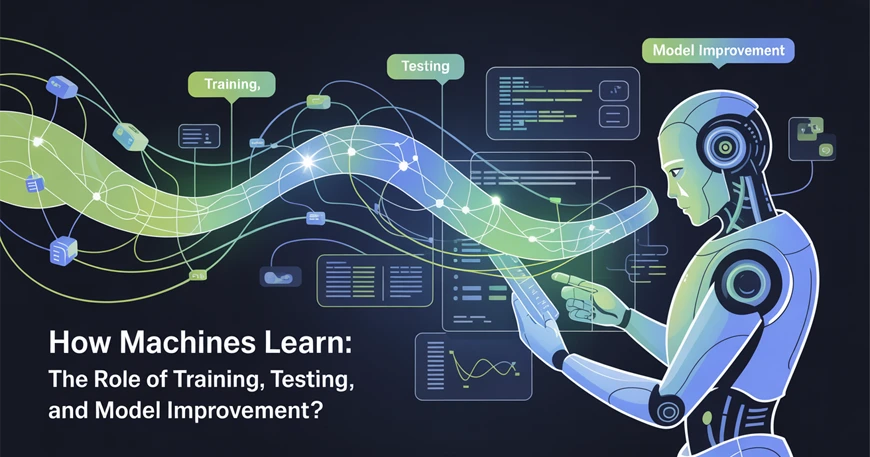
The process can be broken down into three critical stages: training, testing, and model improvement. These phases are the foundation of machine learning models and determine how well algorithms can identify patterns, make predictions, and ultimately solve real-world problems.
In this blog, we’ll explore how machines learn, the importance of each stage, and how model optimization ensures accuracy and reliability.
What Does It Mean for a Machine to Learn?
At its core, machine learning is about teaching computers to recognize patterns in data without being explicitly programmed for every single task.
- Traditional programming: Humans write explicit rules and conditions.
- Machine learning: We provide data and let the algorithm find rules automatically.
For example:
- In spam detection, traditional programming might use specific rules like “if the subject contains ‘free money’ then spam.”
- With machine learning, the system analyzes thousands of emails, learns the characteristics of spam vs. non-spam, and makes predictions without hardcoded rules.
The Role of Training Data
Imagine teaching a child to identify animals by showing them many examples of cats and dogs. Similarly, machines require large amounts of labeled or unlabeled data to begin understanding patterns.
Types of Training in Machine Learning
1. Supervised Learning:
- The model is trained on labeled data (input + correct answer).
- Example: Predicting house prices with input variables like size, location, and asking price.
2. Unsupervised Learning:
- The model works with unlabeled data and finds patterns by itself.
- Example: Grouping customers into clusters based on shopping habits.
3. Reinforcement Learning:
- The model learns through trial and error, receiving rewards or penalties for actions.
- Example: Training AI to play chess or control a robot.
Why Training is Crucial
- Allows the machine to memorize patterns and relationships.
- Prepares it to handle unseen data effectively.
- The better the training dataset, the more accurate the model becomes.
Testing the Model
Once the model is trained, the next step is testing—evaluating how the model performs on new, unseen data.
Why is this necessary? Because a machine might perform perfectly on training examples but fail badly on new inputs. This problem is called overfitting, where the model memorizes training data but doesn’t generalize well.
Common Methods of Model Testing
1. Train/Test Split:
- Dataset is divided (e.g., 80% training + 20% testing).
- Ensures the model is tested fairly on unseen cases.
2. Cross-Validation:
- Data is split into smaller folds, and multiple rounds of training/testing are conducted.
- Provides a more reliable performance estimate.
3. Evaluation Metrics:
- Accuracy: Overall correctness of predictions.
- Precision & Recall: Useful when data is imbalanced (like fraud detection).
- F1-Score: Balances precision and recall.
- AUC-ROC Curve: Measures performance across thresholds.
The Goal of Testing
Testing answers the key question:
“Can this model make accurate predictions on real-world data, beyond the dataset it was trained on?”
Model Improvement: The Key to Smarter AI
Training and testing are essential starting points, but continuous improvement is what makes a machine learning model reliable in production.
Common Techniques for Model Improvement
1. Feature Engineering:
- Selecting or creating the right input variables significantly boosts model performance.
- Example: Adding “total orders in the last 30 days” as a feature in churn prediction.
2. Hyperparameter Tuning:
- Adjusting algorithm-specific parameters (like learning rate in neural networks or maximum depth in decision trees).
- Automated tools like Grid Search and Random Search help identify the best settings.
3. Ensemble Methods:
- Combining multiple models for better results.
- Example: Random Forest (collection of decision trees).
4. Regularization:
- Prevents overfitting by penalizing overly complex models.
- Example: L1 and L2 regularization in regression models.
5. Data Augmentation:
- Expanding training data by making small tweaks.
- Example: Flipping or rotating images in computer vision tasks.
6. Continuous Retraining:
- As data changes over time (customer preferences, market trends, etc.), models must be updated frequently.
- Known as “model lifecycle management.”
Real-World Applications of Training, Testing, and Model Improvement
To understand why these steps matter, let’s look at practical AI examples:
- Healthcare: Training models on patient records, testing them with new hospital data, and improving diagnosis accuracy over time.
- Finance: Credit scoring models trained on past repayment data, tested with current customer info, and enhanced with updated economic trends.
- E-commerce: Recommendation engines continuously tested and improved with new browsing and buying patterns.
- Autonomous Driving: Car AI systems trained with road data, tested in simulations, and improved regularly to adapt to new traffic conditions.
Challenges in the Learning Process
While the process might seem straightforward, building effective AI models comes with unique challenges:
- Data Quality Issues – Incomplete, noisy, or biased data leads to poor predictions.
- Overfitting vs. Underfitting – Finding the right balance between memorizing and generalizing is tricky.
- Computational Costs – Training deep neural networks requires massive computing power.
- Ethical Concerns – Bias in training data may lead to unfair predictions.

