

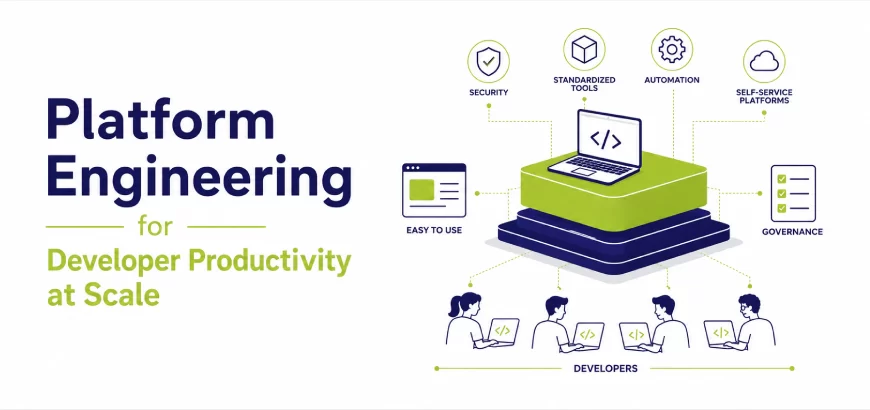
The most common productivity challenge in scaling engineering organizations is not a skills gap - it is a systems gap. As teams grow, the infrastructure and tooling that supports them rarely scales at the same pace. The result is an invisible tax on developer time: hours spent navigating complexity that could have been abstracted, automated, or eliminated entirely.
This is not a problem that resolves itself. Left unaddressed, infrastructure complexity compounds - slowing delivery cycles, increasing onboarding time, and forcing engineers into operational roles they were never intended to fill. Organizations that recognize this pattern early are the ones that maintain engineering velocity as they grow.
Platform engineering is the discipline that turns this around. It brings product thinking to internal infrastructure - building the tools, workflows, and standards that allow development teams to operate independently, ship confidently, and scale without friction.
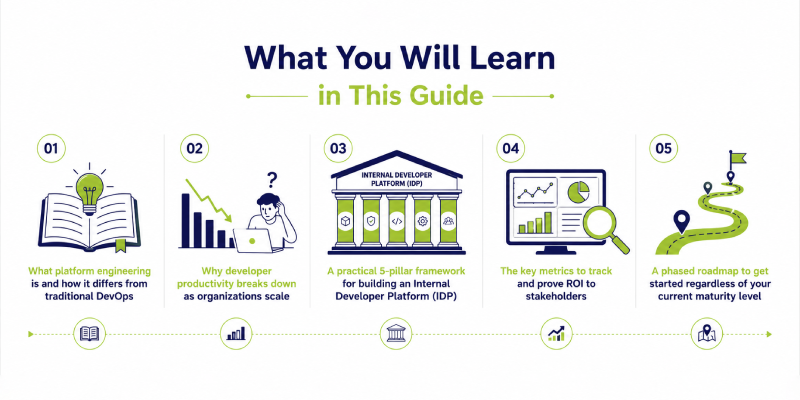
What You Will Learn in This Guide
What platform engineering is and how it differs from traditional DevOps
Why developer productivity breaks down as organizations scale
A practical 5-pillar framework for building an Internal Developer Platform (IDP)
The key metrics to track and prove ROI to stakeholders
A phased roadmap to get started regardless of your current maturity level
The business case is clear. Here is what the data says:
of developers spend >50% time on non-core tasks (DORA 2023)
faster deployment with Internal Developer Platforms
reduction in cognitive load via self-service tooling
avg. annual savings from reduced toil per 100 engineers
Platform engineering is now recognized by Gartner as one of the top 10 strategic technology trends. By 2026, over 80% of large software engineering organizations are expected to establish platform engineering teams.
1. What Is Platform Engineering?
Platform engineering is the practice of designing, building, and maintaining the internal tooling and infrastructure that software developers rely on daily. Unlike traditional DevOps - which focuses on the cultural shift between development and operations - platform engineering creates a product-centric layer between developers and the underlying infrastructure.
At its core, platform engineering produces an Internal Developer Platform (IDP): a curated set of self-service tools, workflows, APIs, and best practices that abstract away infrastructure complexity. Developers interact with the IDP to spin up environments, deploy applications, monitor services, and manage secrets - without needing deep expertise in the underlying systems.
Platform Engineering vs. DevOps: Key Distinctions
2. The Developer Productivity Problem
Developer productivity is not simply about writing more code - it is about reducing friction in every part of the software delivery lifecycle. Research by McKinsey & Company identifies three primary dimensions of developer productivity: flow state (focused, uninterrupted work), feedback loops (speed of testing and deployment cycles), and cognitive load (mental effort spent on non-core tasks).
When developers must context-switch between managing Kubernetes clusters, writing Terraform scripts, debugging CI pipelines, and waiting for infrastructure tickets to be resolved, their ability to enter a productive flow state plummets. This "developer toil" is expensive, demoralizing, and entirely solvable.
Common Developer Productivity Killers
- ⚠Waiting hours or days for environment provisioning
- ⚠Inconsistent toolchains across teams leading to tribal knowledge
- ⚠Complex, undocumented deployment pipelines with high failure rates
- ⚠Lack of observability - developers cannot see what their services are doing
- ⚠Security and compliance bottlenecks slowing release cycles
- ⚠Manual, error-prone infrastructure configuration
3. The Platform Engineering Framework: A Practical Approach
Implementing platform engineering is not a one-size-fits-all endeavor. However, a structured framework helps organizations move from chaos to clarity. Below is a proven five-pillar model for building an effective internal developer platform.
Pillar 1: Define the Golden Path
A golden path is an opinionated, curated, and well-supported route for developers to build, test, and deploy applications. It does not restrict creativity - it eliminates unnecessary decision fatigue by providing sensible defaults.
- Define standard application templates (e.g., microservice, serverless, data pipeline)
- Provide pre-configured CI/CD pipelines that adhere to security and compliance requirements
- Document the golden path and make it easily discoverable via an internal developer portal
Golden paths should be paved, not enforced. Developers should be able to deviate when necessary, but the path of least resistance should always be the correct one.
4. Key Technologies in the Platform Engineering Ecosystem
Developer Portal
Backstage, Port, Cortex
CI/CD Automation
GitHub Actions, Jenkins, GitLab CI, Tekton
Infrastructure
Terraform, Pulumi, Crossplane, AWS CDK
Kubernetes GitOps
Argo CD, Flux, Helm, Kustomize
Observability
Prometheus, Grafana, OpenTelemetry, Jaeger
Security & Policy
Snyk, OPA, HashiCorp Vault, Falco
Container Registry
Harbor, Amazon ECR, Google Artifact Registry
5. Measuring the Impact: Key Metrics to Track
Platform engineering investments must be tied to measurable outcomes. Track the following metrics to demonstrate business value and continuously improve your platform.
6. Getting Started: A Practical Roadmap for IT Teams
Platform engineering does not require a massive upfront investment. Start small, deliver early wins, and scale deliberately. Here is a phased approach.
7. Real-World Impact: Who Is Leading the Way?
Platform engineering is not theoretical - some of the world's most productive engineering organizations have built it into their DNA. Spotify created Backstage (now a CNCF project) to solve internal tooling fragmentation across hundreds of teams. Netflix built a comprehensive IDP that supports thousands of microservices with minimal operational overhead. Airbnb's platform engineering team reduced new service deployment time from days to under 30 minutes.
These organizations demonstrate that the investment in platform engineering pays dividends not just in speed, but in developer satisfaction, reduced burnout, and improved system reliability.
According to the 2023 State of DevOps Report by DORA, elite-performing teams deploy 973x more frequently and recover from incidents 6,570x faster than low performers. Platform engineering is a key enabler of this performance gap.
Frequently Asked Questions (FAQ)
Conclusion
Platform engineering represents a fundamental shift in how organizations think about developer productivity. It moves the conversation from 'how do we make our developers work harder?' to 'how do we eliminate the friction that prevents our developers from doing their best work?'
By building a robust internal developer platform - one that provides self-service capabilities, golden paths, standardized tooling, and embedded security - your organization can dramatically accelerate software delivery, reduce burnout, improve system reliability, and ultimately deliver better outcomes for your customers.
The journey begins with a single step: understanding where your developers are losing the most time. From there, every platform improvement is a direct investment in your engineering team's potential.
Platform engineering is not about the tools - it is about treating your developers as customers and continuously improving their experience. Measure, listen, iterate, and repeat.

