

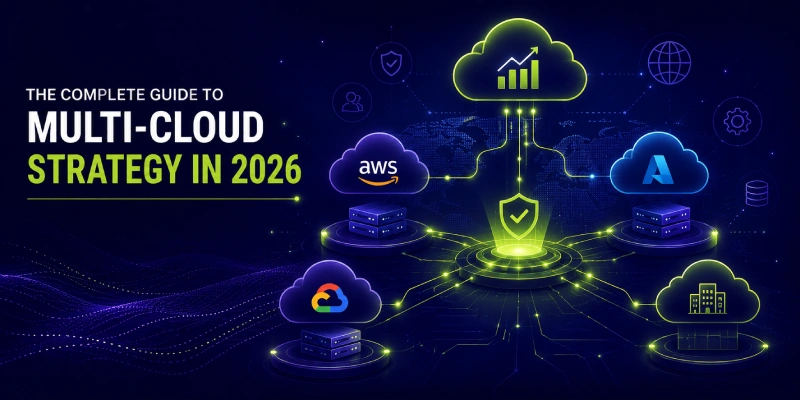
The Complete Guide to Multi-Cloud Strategy in 2026
Discover what multi-cloud strategy is, why businesses need it in 2026, and how to build a resilient, cost-effective multi-cloud architecture.
Why Multi-Cloud Is No Longer Optional in 2026
Cloud computing has moved far beyond a competitive advantage — it is now the backbone of modern digital operations. Yet organisations that rely on a single cloud provider are increasingly discovering the risks: outages, price hikes, compliance gaps, and feature lock-in that limits flexibility.
In 2026, multi-cloud strategy has become the default approach for enterprises that demand resilience, agility, and control. By distributing workloads across two or more cloud providers — such as AWS, Microsoft Azure, and Google Cloud — businesses can eliminate single points of failure, negotiate better pricing, and leverage best-of-breed services.
This guide breaks down everything you need to know: what multi-cloud really means, why it matters, how to design a winning architecture, and how to avoid the most costly mistakes.
What Is Multi-Cloud Strategy?
A multi-cloud strategy is a deliberate approach of using cloud services from multiple providers simultaneously to run different applications, workloads, or infrastructure components. Unlike a hybrid cloud (which combines on-premise infrastructure with one public cloud), multi-cloud involves two or more public cloud platforms working in parallel.
Multi-cloud is not the same as hybrid cloud. Hybrid cloud pairs on-premise infrastructure with a single public cloud. Multi-cloud uses two or more public cloud providers — the distinction is critical for architecture decisions.
Common multi-cloud combinations in 2026 include:
- AWS for compute-intensive workloads and global CDN
- Microsoft Azure for enterprise identity, compliance, and Microsoft 365 integrations
- Google Cloud for AI/ML workloads and big data analytics
- Oracle Cloud for mission-critical ERP and database workloads
6 Reasons Organisations Are Adopting Multi-Cloud in 2026
| # | Strategic Driver | Business Impact |
|---|---|---|
| 1 | Eliminate Vendor Lock-In | Freedom to switch or negotiate — protects long-term pricing and flexibility |
| 2 | Maximise Uptime & Resilience | Failover across providers ensures near-zero downtime even during outages |
| 3 | Best-of-Breed Services | Use the strongest service from each provider (e.g., GCP for AI, Azure for AD) |
| 4 | Regulatory Compliance | Meet data sovereignty and residency requirements across multiple jurisdictions |
| 5 | Cost Optimisation | Leverage competitive pricing and spot instances across multiple platforms |
| 6 | Geographic Expansion | Deploy to regions where your primary provider has limited presence |
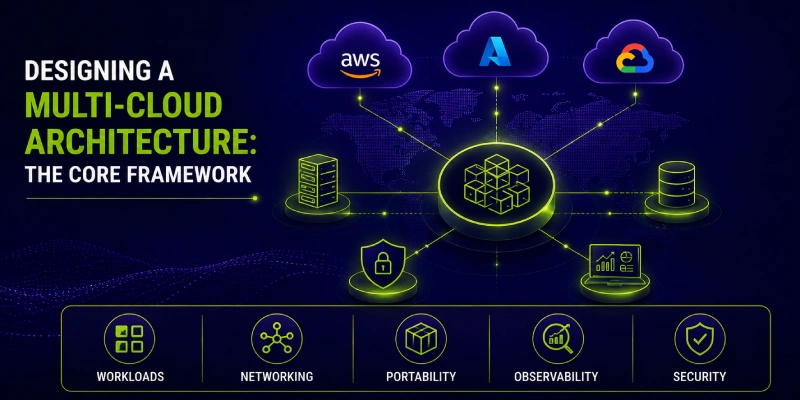
Designing a Multi-Cloud Architecture: The Core Framework
Building a multi-cloud architecture is not simply about spinning up instances on multiple platforms. It requires a principled design that addresses connectivity, portability, observability, security, and governance — from day one.
1. Workload Classification — Know What Goes Where
Not every application belongs on every cloud. Begin by classifying your workloads:
- Performance-critical workloads: Run on the provider offering the best compute or network proximity to your users.
- Compliance-sensitive data: Anchor to the provider with the strongest certifications in your target regulatory jurisdiction (GDPR, HIPAA, PCI-DSS).
- AI and ML pipelines: Leverage Google Cloud Vertex AI or AWS SageMaker depending on model requirements.
- Legacy enterprise workloads: Often best suited for Azure given Microsoft ecosystem integrations.
Explore Our Cloud Services
Looking to implement a multi-cloud strategy for your organisation? Discover how our end-to-end cloud transformation services can help you architect, secure, and optimise your multi-cloud environment.
5 Costly Multi-Cloud Mistakes to Avoid
| Common Mistake | The Right Approach |
|---|---|
| Using multi-cloud without a strategy | Define workload placement criteria and governance policies before migrating |
| Ignoring egress costs | Model data transfer costs carefully — they can erode expected savings quickly |
| Siloed cloud teams | Build a central Cloud Centre of Excellence (CCoE) with shared standards |
| Neglecting FinOps practices | Implement tagging policies and cloud cost management tools from day one |
| Underestimating complexity | Invest in staff training and managed services to reduce operational overhead |
Multi-Cloud Governance & FinOps: Controlling Costs and Compliance
Without strong governance, multi-cloud environments can spiral into uncontrolled spending and compliance gaps. The FinOps Foundation recommends a three-phase approach:
Essential Multi-Cloud Management Tools in 2026
| Category | Leading Tools | Primary Use Case |
|---|---|---|
| Orchestration | Kubernetes, Terraform, Pulumi | Workload portability and infrastructure-as-code |
| Observability | Datadog, New Relic, Grafana Stack | Cross-cloud monitoring and alerting |
| Security (CSPM) | Wiz, Prisma Cloud, Orca Security | Continuous posture management and compliance |
| Cost Management | CloudHealth, Apptio, Spot.io | FinOps, rightsizing, and budget governance |
| Networking | Aviatrix, Alkira, Cisco SD-WAN | Secure multi-cloud connectivity and routing |
| Service Mesh | Istio, Consul Connect | Microservices traffic management across clouds |
Your Multi-Cloud Strategy Roadmap: A 5-Step Action Plan
Assess & Classify
Audit your existing workloads. Classify by performance requirements, data sensitivity, compliance obligations, and provider dependencies.
Design Your Architecture
Define your cloud placement model. Choose an abstraction layer (Kubernetes, Terraform). Plan your networking, security, and identity strategy.
Build Your Operating Model
Establish your Cloud Centre of Excellence (CCoE). Define tagging standards, cost allocation, and governance policies. Train your teams.
Migrate in Phases
Start with non-critical workloads to build confidence and refine processes. Use pilot projects to validate your architecture before large-scale migration.
Optimise Continuously
Implement FinOps practices, regular architecture reviews, and security audits. Multi-cloud strategy is not a one-time project — it is an ongoing operating discipline.
Frequently Asked Questions (FAQs)
Hybrid cloud combines on-premise infrastructure with a single public cloud provider. Multi-cloud uses two or more public cloud providers simultaneously. While they can overlap, the key difference is that multi-cloud focuses on distributing workloads across public cloud platforms for resilience and flexibility.
Not necessarily. While multi-cloud introduces additional management complexity, it also enables cost optimisation by allowing organisations to run workloads on the most cost-effective provider for each use case, leverage competitive pricing, and use spot or preemptible instances across platforms. With strong FinOps practices, many organisations achieve 20–40% cost savings.
The primary risks include expanded attack surface, inconsistent security configurations across providers, fragmented identity and access management, and reduced visibility. These are mitigated with CSPM tools, centralised IAM, uniform encryption policies, and Zero Trust Architecture (ZTA) principles applied across all cloud environments.
Kubernetes is highly recommended but not strictly mandatory. It is the most widely adopted way to achieve workload portability across cloud providers. Alternatives include managed container services or serverless platforms, but Kubernetes offers the greatest flexibility and is the de facto standard for multi-cloud container orchestration in 2026.
Avoid proprietary managed services where alternatives exist, use open standards (Kubernetes, Terraform, Istio), design applications to be cloud-agnostic using abstraction layers, and maintain infrastructure-as-code (IaC) templates that can be adapted across providers. Regularly test your ability to migrate workloads as part of your DR drills.
A Cloud Centre of Excellence is a centralised team or function that establishes cloud governance standards, best practices, security policies, and cost management frameworks across the organisation. In a multi-cloud environment, the CCoE plays a critical role in ensuring consistency, compliance, and accountability across all cloud platforms.

