

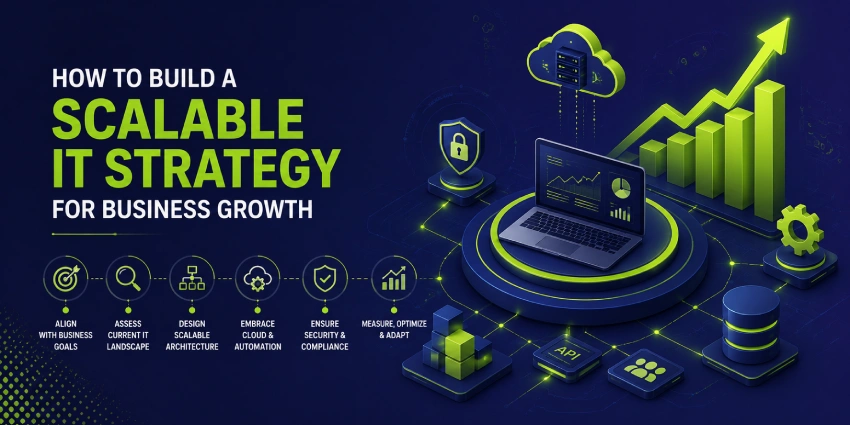
How to Build a Scalable IT Strategy for Business Growth
A practical framework for aligning technology infrastructure with long-term business expansion — without costly rebuilds or downtime.
Every fast-growing business eventually hits the same wall: the technology that got it here can't take it further. Systems built for twenty employees buckle under two hundred. Manual workarounds pile up. Security gaps widen. And every new product launch or market expansion slows down instead of speeding up because IT can't keep pace with the rest of the organization.
This is the scalability trap — one of the most common, and most expensive, strategic failures in growing organizations. The good news is that it's entirely avoidable. A scalable IT strategy isn't about buying more servers or renewing more software licenses. It's a deliberate framework that lets technology expand in step with the business, without constant firefighting or costly rebuilds. Here's how to build one.
What Is a Scalable IT Strategy?
A scalable IT strategy is a long-term technology roadmap designed to expand capacity, functionality, and complexity in step with business growth — without requiring a disruptive overhaul every time the organization crosses a new threshold. It treats infrastructure, security, data, and talent as interconnected systems that must grow together, rather than isolated purchases made in response to the latest bottleneck.
Scalability is not the same as capacity. Capacity is how much a system can currently handle. Scalability is how easily that capacity can expand — in cost, time, and complexity — as demand grows. A strategy built for capacity alone will always need to be rebuilt. One built for scalability grows with the business.
The Real Cost of Unscalable IT
Most leadership teams don't notice unscalable IT until it's already limiting revenue. Systems that once felt sufficient start dictating what the business can and cannot do — which markets it can enter, how fast it can onboard customers, and how quickly it can recover when something breaks.
The scale of the problem shows up clearly in the numbers.
These figures point to the same conclusion: infrastructure decisions made in isolation, without a scalability lens, quietly become growth constraints. The organizations that avoid this outcome treat IT strategy as a business function with a seat in growth planning, not a back-office cost center that gets funded only when something breaks.
Warning Signs Your IT Setup Isn't Built to Scale
Scalability problems rarely appear overnight. They build quietly, showing up as small frictions long before they become full-blown outages or missed growth targets. Recognizing the early signals gives an organization time to act before the cost of fixing them multiplies.
- Onboarding a new employee, customer, or business unit takes noticeably longer than it did a year ago.
- The same manual workaround is repeated by multiple teams because no one has automated it.
- Every new product feature or market launch requires an unplanned infrastructure conversation.
- IT spending grows faster than revenue, with costs arriving in large, unpredictable spikes.
- Security and compliance reviews are treated as separate projects rather than part of system design.
- Reporting and analytics rely on manually stitching data together from disconnected systems.
Any one of these signs, on its own, might just be a minor inefficiency. Several of them appearing together is a strong indicator that the underlying architecture — not any single tool — needs to change.
The Core Pillars of a Scalable IT Strategy
A resilient, future-ready IT strategy rests on six interconnected pillars. Strengthen one without the others, and the system stays fragile.
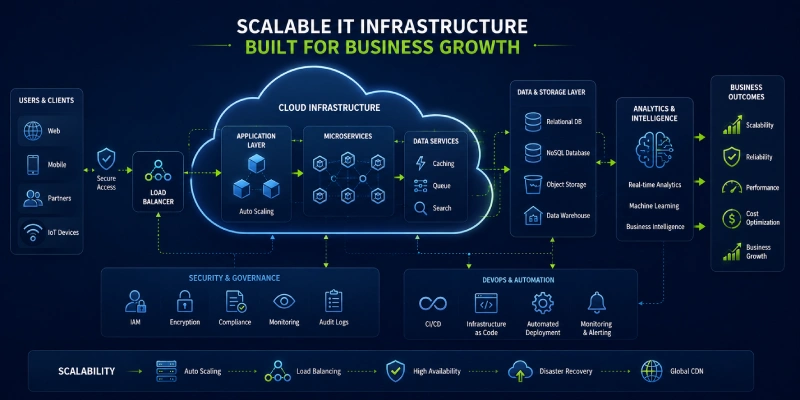
1. Cloud-First, Modular Infrastructure
- Design systems as loosely coupled modules that can scale independently rather than one monolithic environment.
- Favor hybrid or multi-cloud architecture to avoid vendor lock-in and match workloads to the right environment.
- Use infrastructure-as-code so environments can be replicated, adjusted, and scaled without manual reconfiguration.
2. Automation and AI-Driven Operations
- Automate repetitive operational tasks — provisioning, patching, monitoring — to reduce human error and free up capacity.
- Apply AI-driven monitoring to detect performance issues before they affect users.
- Treat automation as a scaling multiplier: it lets a lean team support a growing system.
3. Security Built In, Not Bolted On
- Architect for zero-trust principles from the outset, rather than layering security controls on afterward.
- Build compliance and access governance into the infrastructure design, not into a separate audit process.
- Treat every scalability decision as a security decision — new capacity means new attack surface.
4. Data Architecture That Grows With You
- Centralize data in a structure that supports both current reporting needs and future analytics or AI use cases.
- Avoid siloed systems that make it difficult to get a unified view of the business as it expands.
- Prioritize data quality and governance early — retrofitting it at scale is significantly more expensive.
5. Governance and Talent Alignment
- Define clear decision-making ownership for technology investments as the organization grows.
- Build internal capability through training rather than relying solely on external hires for every new skill gap.
- Align IT roadmaps with business planning cycles, not just annual budget reviews.
6. Continuous Monitoring and Cost Optimization
- Track infrastructure utilization regularly so capacity decisions are based on actual usage, not guesswork.
- Build in cost visibility tools so spend scales predictably alongside performance, not ahead of it.
- Treat scalability as an ongoing discipline — revisit assumptions as the business, and the technology landscape, evolve.
A Scalable IT Strategy in Practice
Consider a mid-sized services company preparing to double its customer base within eighteen months. Rather than waiting for systems to strain under the new load, its technology team maps growth targets to infrastructure needs upfront: cloud capacity is provisioned to scale automatically, onboarding workflows are automated ahead of the surge, and security controls are extended to cover new data volumes before they arrive. When growth accelerates faster than projected, the systems absorb it without a single emergency rebuild — because the scaling was designed in from the start, not bolted on after the fact.
A Step-by-Step Framework to Build Your Scalable IT Strategy
Assess current-state infrastructure. Map existing systems, dependencies, and known bottlenecks before making any new investment decisions.
Align IT goals with business growth targets. Translate revenue, headcount, and market expansion plans into concrete infrastructure and data requirements.
Prioritize modular, cloud-native architecture. Choose systems that can scale in increments rather than requiring full replacement at each growth stage.
Build automation into core operations early. Identify the highest-friction manual processes and automate them before they become scaling bottlenecks.
Embed security and compliance from day one. Design access control, encryption, and monitoring into the architecture rather than adding them later.
Establish metrics and review cadence. Track system performance, cost-per-capacity, and downtime, and revisit the strategy on a fixed quarterly or biannual cycle.
Scalable IT vs. Traditional IT: A Side-by-Side View
| Dimension | Traditional IT Approach | Scalable IT Strategy |
|---|---|---|
| Infrastructure model | Fixed capacity, provisioned for peak load | Elastic capacity, scales up or down on demand |
| Response to growth | Reactive rebuilds and emergency spend | Planned expansion within existing architecture |
| Security approach | Added after systems are built | Embedded into architecture from day one |
| Decision-making | Based on assumptions and habit | Based on usage data and forecasting |
| Cost pattern | Large, unpredictable capital spikes | Predictable, usage-aligned operating cost |
Key Metrics to Track Once Your Strategy Is Live
A scalable IT strategy isn't a one-time project — it's a system that needs ongoing measurement to confirm it's actually working. The following metrics give a practical, business-relevant view of how well infrastructure is keeping pace with growth.
Time to provision new infrastructure or onboard a new business unit.
Cost per unit of capacity, tracked over time rather than as a single snapshot.
System uptime and mean time to recovery after an incident.
Percentage of operational tasks that are automated versus manual.
Ratio of planned infrastructure spend to unplanned, emergency spend.
Reviewing these metrics on a fixed cadence — rather than only when something breaks — is what separates a genuinely scalable strategy from one that simply looks good on paper.
Common Mistakes That Undermine IT Scalability
- Treating IT as a support function instead of a strategic driver of growth.
- Buying point solutions to fix immediate problems without evaluating long-term fit.
- Delaying automation and governance until systems are already under strain.
- Underinvesting in documentation, making systems harder to scale or hand over.
- Reviewing IT strategy only during a crisis rather than on a regular planning cycle.
Frequently Asked Questions
Start with an honest assessment of current infrastructure, including hidden dependencies and known failure points. A scalable strategy can only be built on an accurate understanding of where the business stands today.
Digital transformation is typically a broader shift in how technology is used across the business, including culture and processes. A scalable IT strategy is the underlying technical and architectural plan that makes sustained transformation possible without repeated rebuilds.
No. Cloud infrastructure removes physical capacity limits, but scalability also depends on automation, security design, data architecture, and governance. Moving to the cloud without addressing these areas simply moves the bottleneck rather than removing it.
Most organizations benefit from a formal review every two quarters, with lighter check-ins tied to major business milestones such as funding rounds, new market entry, or significant headcount growth.
It often costs less over time. While some modular and cloud-native investments carry a higher initial price than quick fixes, they avoid the larger, unplanned rebuild costs that unscalable systems eventually require.
Ownership works best as a shared responsibility between technology leadership and business leadership. Technology teams design and maintain the architecture, while business leaders provide the growth targets and priorities that shape what needs to scale first.
When routine business activities — onboarding, launching a feature, entering a new market — consistently require unplanned technology work, that's a strong signal the current infrastructure was not designed with scalability in mind.
Ready to Build IT That Scales With You?
A scalable IT strategy is easier to plan than to retrofit. If your infrastructure needs a roadmap built for where the business is headed — not just where it stands today — our team can help you design one.
Explore Our IT Consulting Services
