

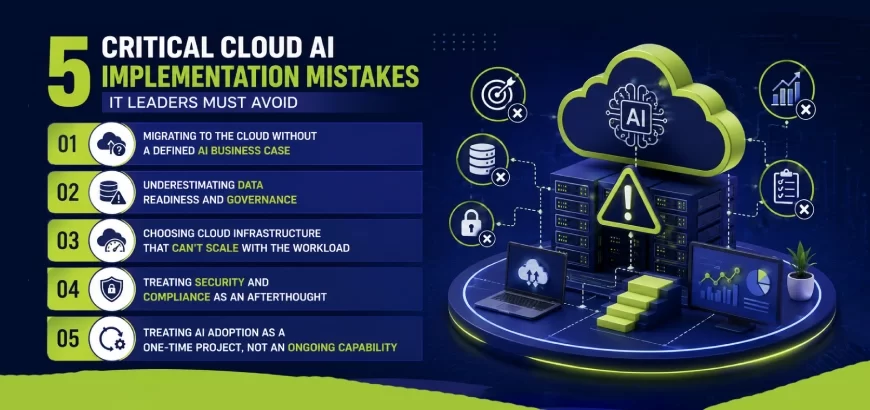
5 Critical Cloud AI Implementation Mistakes IT Leaders Must Avoid
Cloud AI initiatives often fail for avoidable reasons. Explore critical implementation mistakes and a practical framework to drive real ROI.
Cloud AI promises faster decisions, leaner operations, and a durable competitive edge. Yet the data tells a more sobering story: more than 80% of enterprise AI projects fail to deliver their intended business value — roughly twice the failure rate of conventional IT projects, according to RAND Corporation.
The gap between ambition and outcome rarely comes down to weak algorithms or underpowered infrastructure. It comes from a handful of avoidable missteps made early in the implementation journey. This guide breaks down the five most damaging mistakes, and a practical framework for avoiding them.
Why Cloud AI Initiatives Struggle to Deliver ROI
AI failure is organizational far more often than it is technical. Poorly defined success metrics, weak data foundations, and fading executive sponsorship account for most stalled or abandoned cloud AI initiatives — a pattern reflected separately in research from both RAND Corporation and Gartner.
Migrating to the Cloud Without a Defined AI Business Case
Many cloud AI initiatives begin with a technology choice — a model, a platform, a vendor demo — rather than a business outcome. Without a measurable target, teams often build impressive proofs of concept that never translate into production value.
- Anchor the initiative — tie it to one measurable business metric, such as reduced processing time or lower support costs.
- Secure sponsorship — identify an executive owner accountable for outcomes, not just budget.
- Define success early — set a clear, quantifiable definition of success before evaluating any tool.
Underestimating Data Readiness and Governance
Cloud AI systems are only as reliable as the data feeding them. Siloed, inconsistent, or poorly governed data undermines even the most sophisticated models, producing unreliable outputs that erode stakeholder trust.
- Run a data audit — assess completeness, consistency, and accessibility before deployment begins.
- Establish governance — assign clear data ownership and quality standards, including who signs off before a dataset is considered production-ready.
- Unify the pipeline — invest in a consolidated data layer before scaling models.
"The organizations that get cloud AI right treat data governance as infrastructure, not paperwork."
Choosing Cloud Infrastructure That Can't Scale With the Workload
Infrastructure sized for a pilot rarely holds up in production. Skipping capacity planning, autoscaling, and cost modeling often causes performance bottlenecks or budget overruns as usage grows.
- Build for elasticity — design compute and storage around autoscaling from the outset.
- Benchmark cost — track cost-per-inference and cost-per-workload before committing at scale, and revisit those numbers as usage patterns shift.
- Plan for portability — favor architectures that avoid heavy vendor lock-in.
Treating Security and Compliance as an Afterthought
AI systems frequently process sensitive customer, financial, or operational data. Addressing security and compliance only after a model is built risks costly redesigns, delayed launches, or regulatory exposure.
- Secure by design — build access controls, encryption, and audit logging in from day one.
- Classify data first — understand sensitivity levels before data enters a training pipeline, so restricted or regulated fields are handled differently from the start.
- Map to compliance frameworks — align data handling with relevant regulations early, not retroactively.
Treating AI Adoption as a One-Time Project, Not an Ongoing Capability
Many organizations launch a cloud AI initiative, celebrate go-live, and stop investing. Models drift, and without ongoing monitoring and retraining, performance quietly degrades — a phenomenon known as model drift — until the system is abandoned.
- Build monitoring pipelines — track model performance and data drift through a structured MLOps practice.
- Schedule retraining — set a recurring cadence for model updates based on real-world performance, rather than waiting for a visible drop in accuracy.
- Invest in people — pair every rollout with workforce upskilling and change management.
Avoiding these five mistakes comes down to sequencing — moving through each stage deliberately rather than rushing to deployment. Skipping a stage to save time rarely saves time in the end; it just moves the cost downstream, usually to a point where fixing it is far more disruptive:
|
1
|
Stage:
Define
Business
outcome and executive ownership
|
Outcome:A measurable target before any tool evaluation |
|
2
|
Stage:
Govern
Data audit
and quality standards
|
Outcome:AI-ready, trustworthy data foundations |
|
3
|
Stage:
Architect
Scalable,
cost-visible infrastructure
|
Outcome:A platform that holds up beyond the pilot |
|
4
|
Stage:
Secure
Access
control and compliance mapping
|
Outcome:Regulatory confidence built in, not bolted on |
|
5
|
Stage:
Sustain
Monitoring,
retraining, change management
|
Outcome:Long-term performance and adoption |
Working through this sequence with structured cloud AI implementation services can significantly reduce the planning gaps that cause most initiatives to stall.
Signs Your Cloud AI Implementation Is on the Right Track
Before scaling a cloud AI initiative beyond its pilot phase, confirm a few fundamentals are already in place:
Explore how our structured cloud AI implementation services can turn AI ambition into measurable outcomes.
Explore Cloud AI Implementation Services
