

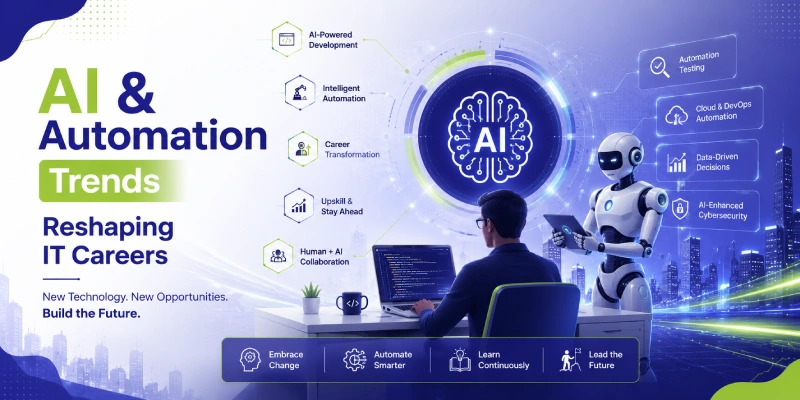
AI and Automation Trends Reshaping IT Careers
Discover how AI and automation are reshaping IT careers. Learn which roles are growing, what skills matter, and how to stay competitive in 2026.
Understanding the Automation Shift in Technology Careers
We have moved past debating whether artificial intelligence will affect technology careers. According to McKinsey Global Institute, approximately 30% of current US jobs could be automated by 2030. For those working in or entering the technology sector, this is not an abstract statistic. It describes the immediate transformation of daily responsibilities, hiring expectations, and required skill sets.
The critical distinction is between tasks being automated and roles being eliminated. AI removes repetitive, rule-based work. It simultaneously amplifies the value of judgement, strategic thinking, and creative problem-solving. Understanding which side of that line your work falls on is the most important career analysis you can do right now.
This guide breaks down the specific roles growing and declining, the tasks most at risk, the skills that will matter most, and a practical four-step framework to help you navigate the transition with confidence.
How AI Automation Is Reshaping Technology Roles
Tasks Being Automated vs. Tasks Being Augmented
Not all tasks face the same fate. Routine and repetitive work faces direct automation. Complex reasoning, stakeholder communication, and creative problem-solving receive AI augmentation — tools that make those tasks faster and better, not obsolete.
High Automation Risk (>30% tasks)
Software code completion & boilerplate — Repetitive generation tasks handled by AI coding assistants
Data entry and routine reporting — Structured, rule-based data processing workflows
Ticket-based Level 1 IT support — Common troubleshooting with known resolution paths
Standard QA test execution — Pre-defined test case running and result logging
Basic log monitoring and alerts — Pattern-matching and threshold-based alerting
AI Augmentation Zone
Architecture design and system evaluation — Requires contextual judgement and trade-off analysis
Insight generation and business interpretation — Translating data into strategic recommendations
Compliance, vendor management, governance — Multi-stakeholder negotiation and oversight
AI orchestration and test strategy design — Deciding what to test, how, and why
Predictive infrastructure and AIOps oversight — Interpreting AI-driven signals and making decisions
Research shows that software developers have approximately 28.7% of tasks automatable and 43.2% augmented by AI. The remaining work is not disappearing — it is becoming more specialised and higher-value. Roles where automation removes simple tasks tend to see wages rise as the remaining responsibilities demand greater expertise.
A 2024 McKinsey survey found that organisations using generative AI in software development reported a 40% increase in developer productivity for routine coding tasks. The time reclaimed is being redirected toward system design, security review, and cross-functional collaboration.
The Shift From Routine Coding to Strategic Engineering
AI coding tools such as GitHub Copilot and Tabnine now handle code completion, boilerplate generation, and routine debugging. These tools do not replace developers — they elevate what developers are expected to do. Writing repetitive code is no longer a differentiating skill. Designing systems, reviewing AI-generated output for correctness and security, and translating business requirements into precise technical specifications have become the core competencies.
Entry-Level Roles Are Transforming Fastest
Employment for software developers aged 22 to 25 declined nearly 20% from its peak in late 2022. Large technology companies hired 50% fewer fresh graduates over the past three years. This is not a sign that the industry is shrinking — it reflects a structural shift. AI now handles the work that historically absorbed junior talent, pushing entry-level professionals into judgement-intensive responsibilities far earlier in their careers. New starters face a steeper but ultimately more rewarding learning curve.
Technology Roles: Growing vs. Declining
AI / ML Engineer — Growing +40%
Demand for AI model deployment at scale
Cloud Infrastructure Engineer — Growing +25%
Cloud adoption across all industry verticals
Cybersecurity Analyst — Growing +28.5%
AI-driven threats require AI-ready defenders
MLOps / LLMOps Engineer — Emerging
Bridge between data science and production
AI Product Manager — Emerging
Translate business needs into AI roadmaps
Prompt Engineer — Emerging
Optimise LLM outputs for business use cases
Junior Developer (routine) — Declining −20%
AI handles boilerplate and grunt work
Level 1 IT Support — Declining −50%
AIOps automating ticket resolution
Standard QA Tester — Evolving
Shifts to AI orchestration and strategy
Data Entry Specialist — Declining
Highly automatable repetitive task profile
Roles With Exceptional Growth: The Numbers
The AI and machine learning engineering field is projected to grow by 40%, generating approximately one million new positions over the next five years. AI automation engineers now command average salaries of $206,000 — an increase of $50,000 in a single year. A single well-deployed AI automation engineer at Vendasta saved 282 workdays annually and recovered $1 million in revenue. The return on investment for these hires is transforming how organisations structure their technology teams.
Cybersecurity job postings surged 11% in Q1 2026 compared to the previous year. Information security analysts face 28.5% projected job growth over the next decade. Headhunters report that roles typically advertised once every 12 months are now appearing weekly. The convergence of AI-powered threats and AI-powered defence is creating one of the most talent-constrained markets in the industry.
The Hybrid Role Phenomenon
One in eight job postings is now classified as a highly hybridised role — combining deep technical expertise with strong interpersonal and business skills. These positions are growing twice as fast as the overall job market and depend on the kind of contextual judgement that AI systems have not yet mastered. Critically, only 16% of hybrid roles are entry-level, indicating that experience and breadth of knowledge carry significant weight.
Skills That Will Define the Next Five Years
The most career-resilient professionals combine technical AI literacy with human capabilities that automation cannot replicate. Both dimensions require deliberate investment.
AI literacy: understanding model behaviour, bias, and limitations
Data fluency: from spotting anomalies to diagnosing root causes
Python and data engineering pipelines
Cloud-native architecture (AWS, Azure, GCP)
MLOps and LLMOps practices
Prompt engineering for LLM interaction
AI security and model governance
Systems-level thinking for API and architecture design
Critical thinking and AI output evaluation
Creative problem-solving under ambiguity
Stakeholder communication (technical to non-technical)
Ethical reasoning around AI decisions
System-level and big-picture thinking
Continuous learning and adaptability
Cross-functional collaboration
Judgment calls that require contextual understanding
A useful distinction: data literacy means spotting that revenue fell 5%. Data fluency means investigating why — examining confounding variables, running comparisons, and presenting actionable solutions. The latter is what employers are paying premiums for. AI-related roles across all industries command 20 to 30% salary premiums over comparable positions. The investment in upskilling pays measurable returns.
AI literacy is the baseline: understanding what AI can and cannot do, recognising when it adds value, and knowing when traditional tools work better. Data fluency goes further — it cultivates the judgment, domain-specific questioning, and communication capabilities that machines lack. Both are now foundational professional expectations.
A Practical Four-Step Framework to Future-Proof Your Career
Awareness without action has no value. The following framework provides a structured path for adapting your career in an AI-augmented environment.
Audit Your Current Role's Automation Risk
Map every responsibility you have against what AI handles well versus poorly. Roles with over 30% automatable tasks face significant transformation in the near term. List your technical, analytical, and interpersonal skills. Ask honestly: are you spending your time on repetitive information processing or on human-centred judgment calls? The answer defines your starting point.
Build T-Shaped Expertise
A T-shaped professional has deep expertise in one domain paired with broad familiarity across adjacent areas. In an AI-augmented market, your vertical depth might be cloud infrastructure while your horizontal bar covers machine learning fundamentals, data engineering, and security governance. This combination allows you to collaborate effectively with both AI systems and cross-functional teams. It also makes you far harder to replace.
Invest in AI Literacy and Continuous Learning
Half of all employees will need reskilling by 2026. Yet 74% of workers use AI regularly while only one-third have received formal training. Close that gap deliberately. Resources such as Google's Machine Learning Crash Course, fast.ai, and DeepLearning.AI offer structured, accessible entry points. Set specific quarterly learning goals, block dedicated daily time, and apply new skills through hands-on projects that you can evidence to employers.
Position Yourself as an AI Collaborator
The most career-resilient professionals treat AI tools as productivity multipliers, not threats. Learn to configure, monitor, and critically evaluate AI outputs in your specific domain. Build a tangible portfolio demonstrating applied competency — not just theoretical certification. Career transitions increased 40% compared to pre-pandemic levels, and skills-based hiring has replaced degree requirements at organisations including Google, Apple, and IBM. Your ability to adapt and demonstrate real-world AI collaboration will determine your trajectory.
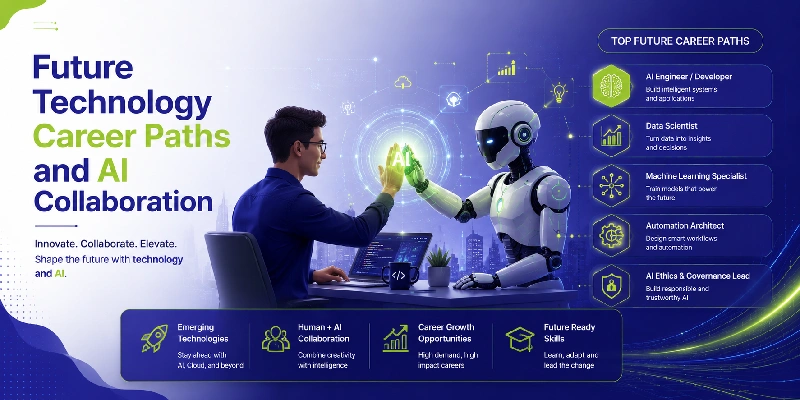
Where to Target Your Transition
If your current role carries high automation risk, the most efficient move is lateral into an adjacent position where your existing knowledge is an asset. The following roles represent accessible transitions depending on your background:
EXPLORE OUR TECHNOLOGY SERVICES
Discover how AI and automation capabilities are being applied across enterprise IT environments — from intelligent cloud operations to AI-augmented security. Our Technology Services page provides practical context for where the market is moving and how organisations are structuring their technology functions today.
Visit UsCertifications from AWS, Microsoft Azure, and Google Cloud — alongside platform-based programmes on Coursera, LinkedIn Learning, and DeepLearning.AI — provide structured, industry-recognised pathways. Pair credentials with demonstrable project work. In today's hiring environment, a portfolio entry showing AI integration in a real-world problem outweighs most certifications.
Frequently Asked Questions
No. AI automates specific task categories — particularly those that are repetitive and rule-based. Roles requiring architectural judgement, stakeholder communication, ethical oversight, and strategic problem-solving remain firmly in the human domain. The professionals most at risk are those who do not adapt to working with AI tools, not technology professionals as a category.
Faster than previous technology cycles. Employment for developers aged 22 to 25 declined nearly 20% from its 2022 peak. Large-scale redundancies in IT support are being announced in months, not years. Organisations that wait to invest in AI capability-building are already experiencing talent gaps. Proactive skill development is significantly more efficient than reactive catch-up.
AI literacy combined with data fluency. Understanding how AI models work, how to evaluate their outputs critically, and how to identify where human judgment supersedes AI capability applies regardless of whether you work in development, operations, security, or management. It is the foundational competency for this era.
Certifications from recognised vendors do hold market value, especially when transitioning roles. They signal foundational competency to hiring managers. However, applied portfolio work — demonstrating that you can use AI tools to solve real problems — carries equal or greater weight in most technical hiring processes. Aim for both.
List every task you perform in a typical week and classify each as rule-based (automatable) or judgment-based (augmentable or durable). If over 30% of your tasks fall into the automatable category, your role faces material transformation. Use that audit to identify where to invest your learning and where to seek adjacent role opportunities.
Financial services, healthcare, retail, and manufacturing lead adoption due to high data volumes and strong ROI on automation. The technology sector itself remains the most intense environment as it is simultaneously builder and consumer of these capabilities. That said, AI adoption is accelerating across all verticals — industry sector is no longer a reliable buffer.
Conclusion: The Opportunity Is Yours to Take
Automation and AI are not eliminating technology careers. They are elevating the standard of what those careers require. The shift is from execution to orchestration, from task completion to strategic enablement.
The professionals who will thrive are not those who resist AI — they are the ones who understand it, work alongside it, and apply it to create outcomes that justify their expertise. Start your skills audit today, commit to building AI fluency in your specific domain, and document your progress in ways that are visible to the market.
Career transitions increased 40% compared to pre-pandemic levels. The average professional changes direction three to four times across their working life. Skills-based hiring has already replaced degree requirements at some of the world's most competitive technology employers. Your ability to adapt will define your trajectory far more than your current job title ever will.
The window to proactively build AI fluency and position yourself ahead of the curve is now. Every month of deliberate investment in the right skills compounds into a substantial career advantage. The technology sector is actively seeking people who bridge the gap between AI capability and real business value — make sure you are one of them.
Ready to Future-Proof Your Technology Career?
Explore how AI and automation capabilities are being applied across enterprise IT environments. Discover the strategies, services, and tools that forward-thinking organisations are using to stay ahead.
Visit Us
