


In 2026, the demand for flexible work authorization in the United States continues to grow, especially among international students, skilled professionals, and dependents of visa holders. One of the most important documents that enables legal employment in the U.S. is the Employment Authorization Document (EAD).
This guide explains what EAD work authorization is, who is eligible, how it works, and why it matters in 2026, in a clear and practical way.
Understanding EAD Work Authorization
An EAD (Employment Authorization Document) is an official permit issued by USCIS (U.S. Citizenship and Immigration Services) that allows non-U.S. Citizens to legally work in the United States for a limited time.
Unlike employer-sponsored visas, an EAD often provides greater job flexibility, making it a preferred option for many professionals and students.
What an EAD Allows You to Do?
An EAD gives you the legal right to work with significant freedom:
- Work for any U.S. employer
- Change jobs without filing a new petition
- Work full-time or part-time
- Accept contract or freelance roles
This flexibility is one of the biggest advantages of EAD work authorization.
Who Needs an EAD in 2026?
Not everyone requires an EAD, but many non-immigrants depend on it to work legally. Here are the common EAD eligible categories:
Spouses of H-1B holders with approved I-140.
Spouses of L-1 visa holders.
Refugees and asylum applicants pending status.
EAD vs Visa: Key Differences Explained
Many people confuse an EAD with a visa, but they serve different purposes. In simple terms, a visa controls your immigration status, while an EAD controls your right to work.
| Feature | Visa | EAD |
|---|---|---|
| Main Purpose | Allows entry and stay in the U.S. | Allows legal employment |
| Employer Link | Usually employer-specific | Typically employer-independent |
| Flexibility | Low (often tied to one employer) | High (can change jobs freely) |
Types of EAD Work Authorization
There is no single EAD type. USCIS issues EADs under different eligibility categories.
OPT EAD
For: International students after graduation.
Validity: Typically 12 months.
Allows students to work in their field of study to gain practical experience.
STEM OPT EAD
For: STEM graduates (Science, Technology, Engineering, Mathematics).
Validity: 24-month extension.
Provides a longer work period for those in designated STEM fields.
H-4 EAD
For: Eligible H-1B dependents.
Validity: Up to 2 years.
Allows spouses of H-1B workers to be employed while the primary worker holds the H-1B.
I-485 Pending EAD
For: Green card applicants (Adjustment of Status).
Validity: Up to 2 years.
Enables work while the green card application is being processed.
How to Apply for an EAD in 2026
The EAD application process is straightforward but requires accuracy. Processing times in 2026 typically range between 2 to 5 months.
Submit the application for employment authorization to USCIS.
Provide passport, visa proof, I-94, and category-specific approvals.
If required, attend the appointment for fingerprinting and photos.
Get your physical EAD card and verify eligibility with your employer.
Documents Required
- Passport (valid)
- Current visa or status proof
- I-94 record
- Previous EAD (if renewing)
- Category-specific approvals (I-20, I-140, I-485, etc.)
- Recent passport-size photographs as per USCIS guidelines
Submitting incomplete or incorrect documents is one of the main reasons for delays.
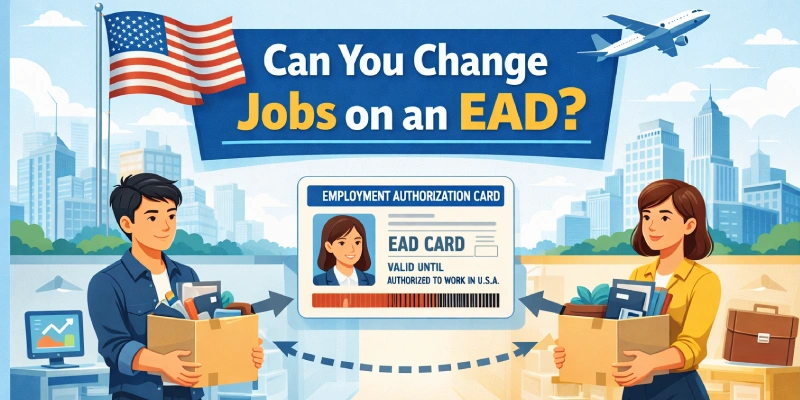
Can You Change Jobs on an EAD?
Yes—and this is one of the biggest advantages. With an EAD, you can:
Move freely between companies without sponsorship.
Accept remote or hybrid roles without restriction.
Take on freelance or contract jobs.
This flexibility makes EAD especially popular in IT, healthcare, consulting, and engineering roles.
EAD Renewal Rules You Must Know
- Apply up to 180 days before expiration.
- Some categories get automatic extensions.
- Working after expiry without renewal is illegal.
- Processing delays can impact job continuity.
Planning ahead avoids compliance issues for both employees and employers.
EAD and Green Card Pathway
For many professionals, EAD is a stepping stone toward permanent residency. In adjustment of status cases:
- EAD allows you to work while your green card is processing.
- You are not limited to one employment.
- You gain employment stability during long USCIS timelines.
- You gain flexibility to change roles or advance your career without affecting your application.
This makes EAD a powerful tool in long-term immigration planning.
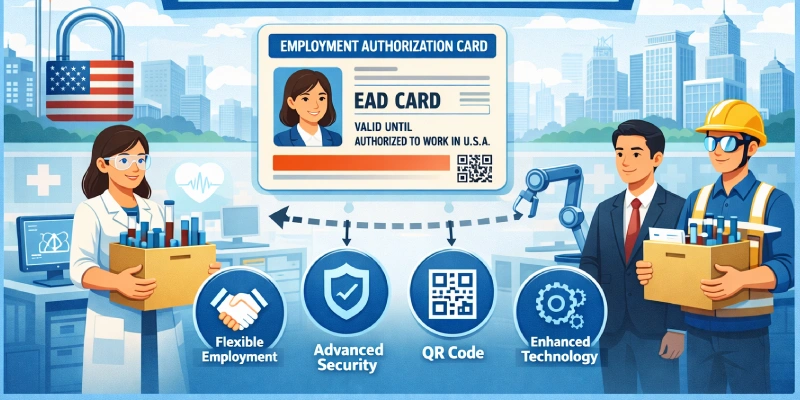
EAD Work Authorization in 2026: What’s New?
In 2026, EAD continues to play a key role due to:
- Increased processing digitization
- Expanded automatic extension rules
- Higher demand for flexible employment authorization
- Growing use of AI in USCIS case review systems
Employers are also more aware and accepting of EAD candidates than ever before.
Common EAD Mistakes to Avoid
Even small errors can cause delays.
Choosing the wrong eligibility category.
Missing renewal deadlines.
Submitting incorrect supporting documents.
Final Thoughts
An EAD Work Authorization is more than just a card—it’s a gateway to career growth, flexibility, and opportunity in the U.S. In 2026, as immigration systems evolve and job markets demand agility, EAD remains one of the most valuable employment tools for non-citizens.
Whether you are a student, dependent, or green card applicant, understanding how EAD works empowers you to make better career and immigration decisions.
FAQs
Only if your visa explicitly allows employment. For example, H-1B allows work, but B-1/B-2 tourist visas do not.
It depends on your goal. EAD offers job flexibility, while H-1B offers a specific long-term sponsorship pathway for permanent residency.
Yes, EAD holders can work remotely, unless restricted by specific category rules (e.g., some STEM OPT requirements).
Most applicants can apply up to 180 days before the EAD expiration date.
